
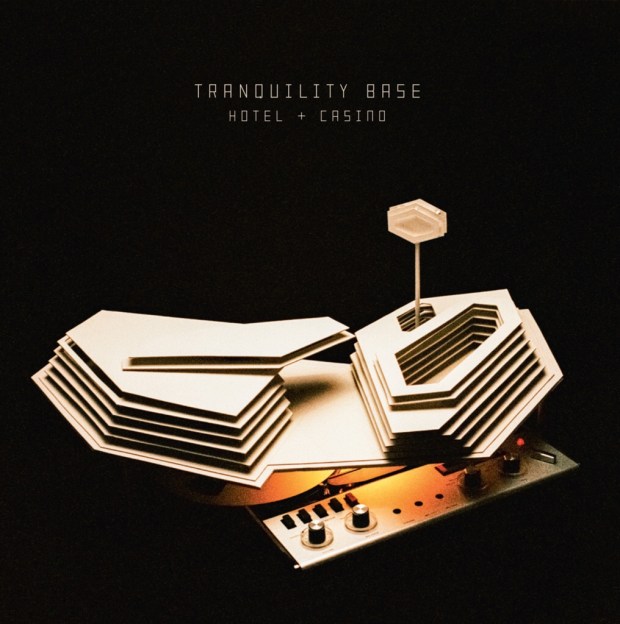
Quick Review: Arctic Monkeys – Tranquility Base Hotel & Casino

Rating: ✪✪✪

The fact that this will take its place as the weakest link of Arctic Monkeys’ repertoire doesn’t really tell the whole story.

And that’s because, well, in truth Tranquility Base Hotel & Casino is far more interesting for what it is than what it does – it’s a lounge album from a band that has built their mythos on their versatile and enduring knack for producing solid, memorable pop singles.

It’s also the most conceptually focused album you will have probably have heard in some time. More than simply being one of those records with some thematic continuity threaded in tracks, this album can only really be made sense of as a single body of a work; a vivid portrayal of a fantastical lunar hotel bar that is, despite being on the moon, still very much a hotel bar.

Now, while lyrically and technically more adventurous than anything we’ve heard from Alex Turner before, I can’t say this album does, on the whole, really reward you for listening to it. The songs don’t stick like they usually do with Arctic Monkeys. They don’t make it easy for you to love them.

And perhaps that’s fine. Turner and his compeers have developed musically and personally so much over the years that anything other than another drastic change of style after AM would have been a step backwards.

But that can’t change the overall mood that Tranquility Base seems to represent the end of the group’s creative summer rather than another episode of it. As is simply a truth borne of their stage in the lifecycle of a band of such status, it would seem time to accept that we have probably witnessed the best that will come of Arctic Monkeys already.

Reappraisal: Less than a week later, and I’m already starting to see this record in a kinder light, albeit still with the view that it occupies the tier below all their other releases. Guess this one is really is just as much of a grower as everyone was making out.

Archive: ‘Five Singles to Remember 2017 By’ for Vocal Media

Link to original post on ‘Beat’ (formatting now corrupted)

If there’s one silver lining that history tells us comes of tumultuous times, it’s that they tend to bleed rather well into all things creative.

And while the year twenty-hundred-and-seventeen was always destined to be the long comedown from the intense disaster-trip that was, in so many ways, the year before, it would be rude not to also say that it has introduced us to some interesting new stars and shapes in the kaleidoscope of music.

With the turgid beast of early 2010s stadium-dance EDM now dead, toe-tagged and awaiting burial, there’s been noticeably more breathing space opened up to some of the other genres that make up music’s rich tapestry.

Tech house, electro, bassline and footwork were just some of the styles receiving fresh exposure this year, each gaining traction in the clubs and on the web as they returned to popular music consciousness after years of underground innovation and nichery.

Elsewhere we’ve had ‘mumble rap,’ in all the glory of its fluorescent dreads and weird Xanax iconery, showing everyone that the ouroboros of modern pop culture does sometimes take a break to eat something fresh. Say what you will, but for the first time in far too long, there’s been a new development in music that is foolproof material for confusing the shit out of your parents. Esketiiit.

The last twelve months also saw music take on characteristics of a social movement in the west again for perhaps the first time in a generation, with ‘#Grime4Corbyn’ appearing to have a visible impact on the polls, and the booming politicised underground ‘Cxema’ rave scene in Ukraine beginning to turn heads from further afield.

So, to pick just a handful of tunes mustn’t be fair, right? Well, no, it’s not—but then neither is life, bud, and I’m not sure end-of-year lists go much longer than this without being scrolled past at high speed:

5. Blinded by Your Grace Pt. 2″ — Stormzy

By any possible measure, it has been a year for South London’s favourite son Stormzy. Having been right in the centre of grime’s monumental comeback, the 24-year-old’s independently released LP Gang Signs & Prayer saw a level of debut anticipation genuinely without parallel in British music since Arctic Monkeys’ first outing, leading it to become the first grime album in history to reach number one.

And flatter to deceive it did not, with Stormzy drawing heaps of acclaim for the unapologetic tone of the record’s lyrical content, and the confidence in which he broached different musical styles.

Nowhere is this more apparent than in Blinded by Your Grace pt 2, a triumphant three-minute gospel-infused tune featuring
vocals from MNEK, movingly performed by Stormzy himself at a fan’s father’s funeral this month. It’s grandiose, especially for him, but damn does it work.

4. “Gammy Elbow” — DJ Zinc & Chris Lorenzo

The last year has been a lively one for all things bassline. Buoyed by the renewed success of its sibling genre in grime, we’ve seen the likes of Skepsis, Holy Goof, DJ Q and Jamie Duggan send young’uns into complete frenzy up-and-down UK dancefloors this year, showing that a bit of sub-bass served with a lot of energy goes a long, long way.

The birthers of many a club classic, DJ Zinc and Chris Lorenzo teamed up to do their own in pushing things along with a pearler in “Gammy Elbow,” a marriage of bassline and house sounds that set the beat for all others to follow. Surprising some and entertaining many, it told us
one thing for certain; hard four-to-the-floor is back.

3. “Tour” — Macky Gee


Lump scorn on ‘jump-up’ drum ‘n bass till you’re blue in the keyboard if you wish, but if you found yourself in a dark, sticky club this year and it didn’t absolutely go off when Tour came blaring through then, frankly, I got nothing.

This is the kind of tune that oozes the vibes of many a messy, messy session in its unrelenting — and forgivably repetitive — escape into raw, snarling bass, and offered a healthy sign of life from the remarkably resilient musical force of nasty DnB.

2. “Glue” — Bicep

Haunting, ethereal, and instantly etched in the memory, Glue was nothing less than a pièce de résistance from the most dedicated duo in British dance music, Bicep. It’s no stretch to say that there’s a certain quality to this one that, even when held up to the rest of a superb and varied debut album, completely marks it out from most other things you’ll have heard this year. Of course, Bicep has been by no means a secret for some time now, but it’s hard to believe it’s not in the league of superstar DJs when you listen to this; in a great year for genre fusion in electronic music all-round, this breakbeat-influenced track can be piled at the very top.

1. “Bleeding Heart” — Boris Brejcha

Now two years into managing the roster of his label ‘Fcking Serious’, there should be little doubt left now that Boris Brejcha occupies a particular pride of place in the minimal techno stakes. In one sense, Bleeding Heart is everything one has come to expect from Brejcha, being the kind of portentous, futuristic musical journey that has become his calling card.

And yet, as with everything he does, it’s also very much of its own character and quirk, managing to do so much sonically while doing so little, and straying a safe distance from sounding like a reworking of earlier material. If any genre can be singled out as really pushing the envelope right now, it’s this breed of ‘high tech’ minimal, and with the Berlin techno scene now receiving public funding, there doesn’t seem to be much at all standing in the way of Brejcha and his peers.

‘Chollywood’: is ‘Wolf Warrior 2’ a sign of Chinese film dominance to come?

The box office’s biggest success stories of 2017 make, for the most part, rather easy guesswork.

Star Wars: The Last Jedi. Beauty and The Beast. Spider-Man: Homecoming.

And then there’s one that probably wasn’t on the tip of your tongue: Wolf Warrior 2.

Despite going almost entirely under the radar beyond Asia, the Mandarin-language patriotic action flick made more worldwide last year than some of Hollywood’s biggest hits – not IT, nor Guardians of the Galaxy 2, nor Wonder Woman measured up to director-lead Wu Jing’s Oscar-nominated triumph.

Even more impressively, it also broke through as the first non-Hollywood movie in history to enter the all-time top 100 of films by box office gross, raking in seven times its 2015 prequel.

So what’s going on?

Essentially, the first global ripples of the long-in-the-tooth burgeoning of ‘Chollywood’.

The last twelve months alone have seen multiple moviegoing records in China broken, with the first day of the Chinese New Year celebrations seeing a new single-day takings record and an all-time admission high of 21 million moviegoers.

And though not featuring in Forbes’ latest list due to a quieter schedule, Fan BingBing – introduced to many as the mutant ‘Blink’ in 2014’s X-Men: Days of Future Past – made news the year before when she was named as the fifth highest paid actress in the world.

It seems to say one thing; China’s stars are rising, and fast.

So fast in fact, that you can almost hear Hollywood turning its head across the Pacific in anxiety.

While the likes of the Transformers series have enjoyed wild success in China for some time, in spite of laws restricting theatrical annual foreign releases in the country to a maximum of thirty-four, each domestic blockbuster in the vein of The Mermaid or Monster Hunt is having the effect of making Chinese cinema screens look more and more Chinese.

The screens are starting to look less American, too, with 72% of foreign film box office revenue in China now being non-Hollywood in origin.

With such clear and present danger for the international markets of the American film industry, it’s no wonder that co-productions are increasingly sought after.

One such project billed for 2018 is ‘Confetti’, starring Amy Irving (Sue Snell in the 1975 adaptation of Carrie), which tells the story of a mother whose efforts to care for her dyslexic young daughter takes them from rural China for New York City.

Its dialogue will, according to director Ann Hu, be in “80% English” and “20% Mandarin”, reflecting in its own way what one could see as a shift in in power dynamic; we’ve now got Chinese studios eyeing up English-speaking audiences, rather than solely the other way round.

Interestingly enough, Wolf Warrior 2 itself is the kind of flag-waving, jingoistic shoot-‘em-up that could, thematically, be straight out of the hackneyed Reagan era American cinema of Rambo, Commando et al.

The feature follows Leng Feng (Wu Jing), a retired special ops hero living in an undeterminable African country, who is sprung back into action when his new home is struck by civil war.

The audience is variously treated to imagery of him aiding with the evacuation of his Chinese compatriots, winning an underwater fist fight with pirates, facing-off with Frank Grillo of Captain America fame and contracting an incurable Ebola-type virus from which he is, through his own sheer hardiness, cured.

It’s unsurprisingly been accused of racial insensitivity in its at-best condescending depiction of the natives, whom in full tribal dance and all seem at times a little too willing to worship their Chinese saviours, not to mention a particular line in which Leng’s brother’s in arms talk of the continents “good food, excellent scenery and hot women”, which falls some way short of good taste.

But it’s this kind of bravado and chest-thumping national pride that also holds a great deal of the secret of Wolf Warrior 2’s runaway success. Not unlike the western world, China has been experiencing a resurgent nationalism of late, in no small part fostered by the state’s ever-tightening control of the country’s news cycle in management of its self-image.

It is, indeed, also the state apparatus that poses by far the biggest challenge to the onward march of Chinese film – for as with most things media-flavoured in the world’s most populous country, the boom of the silver screen has not escaped the glare of the censor.

In March the National People’s Congress passed the ‘Film Industry Promotion Law’, a vaguely worded piece of legislation that states that all film shown in the country should “serve the people and socialism”, and not impinge the “dignity, honour and interests” of the nation.

Its implications remain as unclear as its phrasing, but if the words of President Xi Jingping back in 2007 are to be taken as any kind of explanation, it means a dissuasion of releases “talking about bad things in imperial palaces” and an encouragement of projects in the style of 1950s-60s American war films, which he praised for their “grand” nature and strong moral messaging.

All current trends make it seem most unlikely, though, that ‘Chollywood’ will hit its own great wall anytime soon.

According to current market forecasting, it should be safe to place plenty of Yuan on it being a when and not an if we see China becoming the world’s biggest movie market.

Some commentators, such as Paul Dergarabedian of Comscore, say even as early as next year.

There is, however, no way of saying what Chinese film ascendancy will look like yet – nor are we to know what censorship will do, what the era of the Chinese blockbuster will truly look like, and what it will really take for western audiences to, ahem, wolf these films down.
Wi-fi plan for Sheffield City Centre announced

Sheffield City Council has revealed it is looking for a provider to
offer a free Wi-Fi service across the city’s Business
Improvement District (BID).

Under current plans, a contract would be awarded to an internet provider in
June, with the Wi-Fi service expected to be rolled in December this year.

The scheme, set to be approved by the Council’s cabinet next Wednesday
(18 January), would allow a provider to offer high-speed free connection in exchange for use of street
assets used to provide wireless communication services.

Councillor Leigh Bramall, cabinet member for business and economy at
Sheffield City Council, said: “This offer has the potential to place
Sheffield amongst the best connected cities in the country.

“Our ambition is to create the conditions that allow a super-fast,
digitally-connected and vibrant city to thrive. Our economy will benefit
and Sheffield will become more connected for people using the city
centre.

“But we’ll only appoint a provider on our terms – someone who will provide the service at no cost to the public or ourselves.

“We’ve tested the market and believe that a provider will be able to
offer the service we want for Sheffield in exchange for exclusive use of
council-owned street assets such as lampposts.”

The Sheffield Lib Dem opposition, who initially suggested the scheme, have also welcomed the news.

Councillor Richard Shaw said: “We’re really pleased to see the Labour Council have finally got a move on with this project after
we suggested it last year.”

“If this scheme is successful we hope that
they will be ambitious and look to roll out similar schemes in parks and
local district shopping centres.”

Under the proposed terms a provider
would offer a free-of-charge service, potentially including council-owned public
buildings such as the Winter Garden.

There are a number of free Wi-Fi
schemes operating in Sheffield, mainly in pubs and cafe chains, but these do not cover the open spaces
across the city.

Quick review: Sundara Karma – Youth is Only Ever Fun in Retrospect

For what it is, you can’t say Youth is Only Ever Fun in Retrospect is a particularly bad album, especially being a debut. It’s aimed, with incredible precision, at the ‘indie teen’ market, and does a fine job at doing so – the songs are energetic, the choruses catchy and the production impressive. This group are also, I can attest to, good fun to experience live.

The sticking point I’m afraid is just how inconsequential it all is. There’s nothing fresh, nothing original, nothing surprising offered here. It also ranks rather high on the scale of sameyness. In fact, for the most part this could be genuinely be 45 minutes of the same track, and you do have to be paying attention at many points to note where one ends and the next begins. This would be fine if it was the desired effect, but something tells me this is a more of a symptom of levelling out in the studio, and attempting to crowd the radio-friendly middleground.

One listen, while unlikely to an entirely unenjoyable one, should probably be enough.

‘Nothing agreed yet’ on Central Library five-star hotel plan

Sheffield City Council have told a public Town Hall meeting that all options remain open regarding a controversial plan to lease the Central Library and Graves Gallery building to Chinese developers.

The proposals, first brought to the council by
Sichuan Guodong last November, would see the current building become the city’s first five-star hotel, with the library relocated to a new site in the city centre.

The council have stated that they would seek the remaining of the Graves Gallery in the 1930s building, with a view to moving the art collection to the ground floor.

Sichuan Guodong have been given twelve months to assess the viability of a hotel in the Grade II listed building.

Addressing at times anxious members of the public, Councillor Jack Scott, 
Cabinet Member for Community Services and Libraries, said:

“We at the beginning of a very long journey. It is, also, a journey that may not progress at all.”

“We’ve not signed up to do anything for definite, both parties can pull away from this discussion at any time during the twelve month period. ”

Acknowledging that the recent outcry over the handling of a mass tree felling operation had damaged Sheffielders’ trust in the authority, Councillor Scott said the series of meetings served as a way of rebuilding ties with the people of the city.

It was also revealed during the meeting that the short-term costs of urgent repairs to the Central Library building are expected to total £2.2million, and that long-term costs of making the existing site ‘fit for the future’ would be in the region of £30million.

The announcement of the plans has not gone without its critics since November, with many questioning the need for another hotel, and pleading for the council to take its time over a decision.

Rebecca Gransbury, a local book seller who often uses the library, started a petition
calling for the building to remain a library that now has over 10,000 signatures – double the 5,000 required for it to be presented to the council.

Speaking at the meeting after the councillors, she said:

“I don’t think it’s the council’s fault, but there’s not enough information at the moment. We need to have more of these meetings.”

“It’s all a bit one sided – we hear about a lot of the problems of the current library building, but we don’t hear much about the positives – it has a lot. The problem is, really, we can’t balance out the information with any concrete information about the new library.”

The revealing of the plans comes after Sheffield City Council and the Chinese
Sichuan Guodong Construction Group

last August signed a 60-year investment deal totalling £1billion, with £220million to be invested in the next three years.

Sheffield cancer charity collection boxes stolen

A number of collection boxes containing donations for Cavendish Cancer Care have been stolen in a series of thefts around Sheffield.

The two most recent thefts took place at Dore Dental Care on Causeway Head Road and Scott’s Pantry on Glossop Road.

Victoria Wood from the fundraising team at Cavendish Cancer Care said: “We are only a small charity and we really do rely on the generosity of members of the public to be able to continue providing our invaluable services to people affected by cancer.“

"We urge anyone with any information to come forward.”

Anyone with information regarding the thefts in the past few months is being asked to call the police non-emergency number on 101.

Members of the public can also donate £5 to Cavendish Cancer Care by texting ‘CAVC25 £5’ to 70070.

Sheffield MP Clegg returns to Lib Dem frontbenches

Former Deputy Prime Minister and Sheffield Hallam MP Nick Clegg is returning to the Liberal Democrat front bench as the party’s European Union spokesman.

His role will shadow that of David Davis, who was appointed Secretary of State for British exit from the European Union in new PM Theresa May’s cabinet.

Clegg was a Member of the European Parliament and a trade negotiator in the European Commission under former chancellor Leon Brittan.

The former party leader is kicking off his role by announcing his ‘Brexit Challenge’ project.

In the coming weeks and months Clegg will publish a series of papers detailing the potential challenges posed to the nation in lieu of the public’s vote to leave the union.

Writing in the i newspaper, Nick Clegg said:

“Theresa May says Brexit means Brexit but no one actually knows what that means.”

“With no meaningful opposition from the Labour Party, no exit plan from the Government, Whitehall unprepared for the Brexit negotiations, and above all, Theresa May’s refusal to seek a mandate from the people for what is in effect a new government, there is a real risk that she and her Brexit ministers won’t be subject to the scrutiny and accountability which voters deserve.

“Whatever your views on Brexit, it is in everyone’s interest to make sure what happens next is debated openly and scrutinised properly.“

Liberal Democrat Leader Tim Farron said:

“There is no-one better placed in British politics to hold the Government to account over Brexit than Nick.”

“Now that Theresa May’s Brexit government is a reality, I’ve asked Nick to take on a formal role in holding them to account.”

“Over the next months I expect him to be the leading voice in this debate, taking them to task and flushing out what Brexit will really mean for Britain.”

The Liberal Democrat party have previously said that, if elected, they would seek to negotiate continued membership of the EU for the UK.

Sheffield Lib Dems raise New Retail Quarter concerns

The Sheffield Liberal Democrats have welcomed the news the progress being made on the New Retail Quarter project, but have raised concerns over the way decisions on investment are being made.

A cabinet report, set to be approved by the Labour cabinet on Wednesday, requests that the Council triple the amount of investment from the current £61 million to £187million.

The concerns come as the report will not be able to be ‘called-in’ for further scrutiny like other important Council decisions.

Councillor Martin Smith, shadow cabinet spokesperson for business and economy said:

“We support the New Retail Quarter project and we welcome the recent announcement from HSBC about retaining a major presence in Sheffield to keep quality jobs in Sheffield.

However, this project is very unusual as the Council wants to act as a speculative investor and property developer to build shops and office space which is not currently let.

Although we welcome any progress on the retail quarter project, we believe the Labour Council should be more open with people about the risks they are taking with your money.”

The planned New Retail Quarter occupies the site of the ill-fated ‘Sevenstone’ retail project, which fell through amidst the late 2000s economic crisis.