My live coverage of the 2021 local elections, Sheffield City Council governance referendum and South Yorkshire Police & Crime Commissioner.
I ran analysis, live graphics and live reaction from candidates on my independent outlet @NewsSheffield, while also working as correspondent for Now Then Magazine. Ended up a shock result, with Labour losing overall control of Sheffield City Council
#LE2021 in Sheffield: NO OVERALL CONTROL on council after Labour Party loses 8 seats and their majority; a win for Committee Model in Governance referendum on Monday could grant further power to Greens, Lib Dems, and other parties on council #Sheffield#LocalElections2021pic.twitter.com/Dbn3c8r45g
More Green Party reaction from Peter Garbutt @PeterG4NES2019, (Councillor for Nether Edge and Sharrow) speaking to @NewsSheffield: "Lots of hard work to come. We've got to get a working relationship with other parties up and running pretty fast." #LE2021pic.twitter.com/2u0DA6vVPf
Women's Equality Party Sheffield (@WEPSheffield) speaking to @NewsSheffield today on #LE2021: Result in Ecclesall is party's best in city to date. Growing popularity of WEP across country signals other parties need to "step up and take women's experiences seriously", as… pic.twitter.com/xyTFYOND1Q
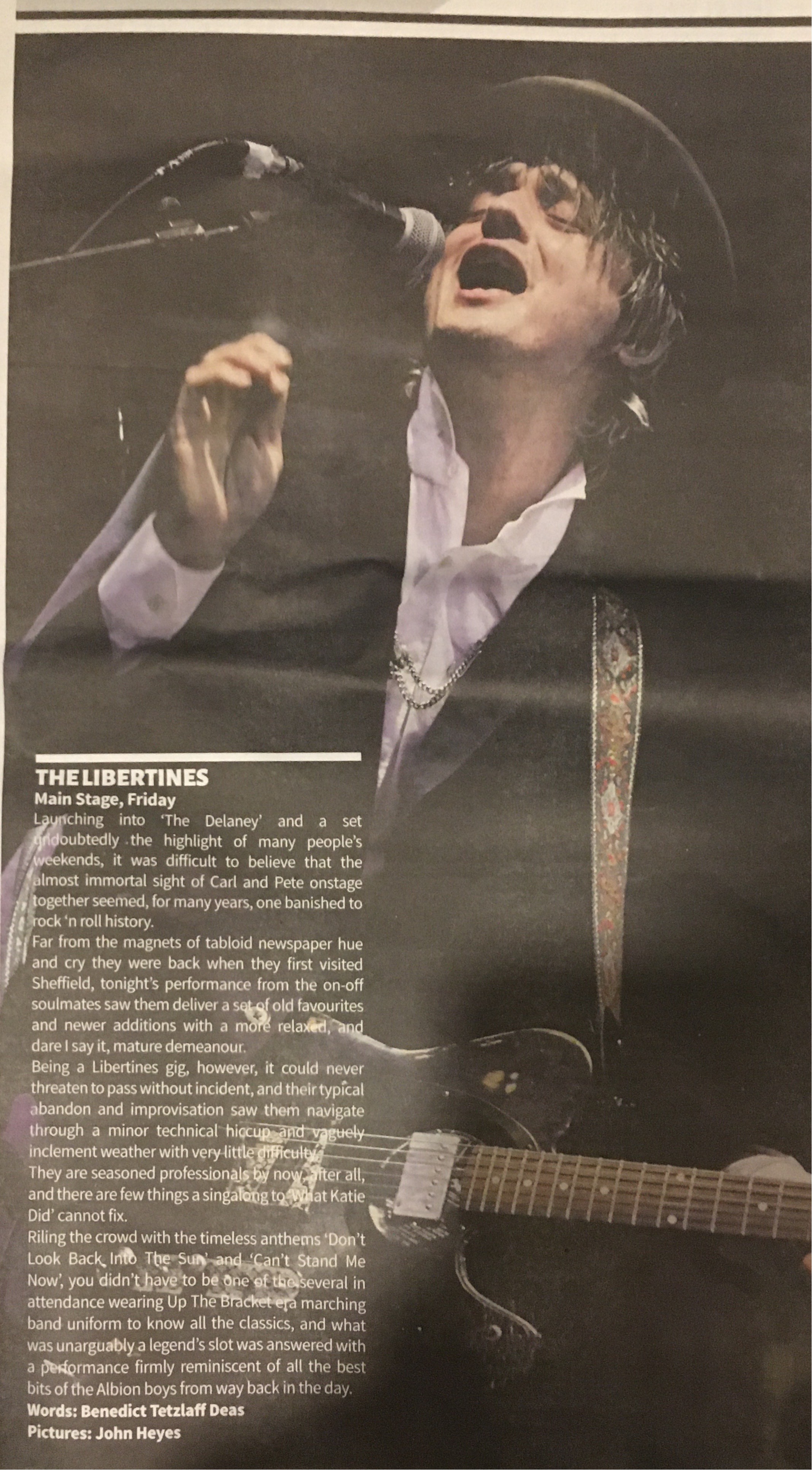
Launching into ‘The Delaney’ and a set undoubtedly the highlight of many people’s weekends, it was difficult to believe that the almost immortal sight of Carl and Pete onstage seemed, for many years, one banished to rock ‘n roll history.
Far from the magnets of tabloid newspaper hue and cry they were when they first visited Sheffield, though, tonight’s performance from the on-off soulmates saw them deliver a set of old favourites with a more relaxed, and dare I say it, mature demeanour.
Being a Libertines gig, however, it could never threaten to pass without incident, and their typical abandon and improvisation saw them navigate through a minor technical hiccup and vaguely inclement weather with very little difficulty.
They are seasoned professionals by now, after all, and there are few things a singalong to ‘What Katie Did’ cannot fix.
Riling the crowd with the timeless anthems ‘Don’t Look Back Into The Sun’ and ‘Can’t Stand Me Now’, you didn’t have to be one of the several in attendance wearing Up The Bracket marching band uniform to know all the classics, and what was unarguably a ‘legend’s slot’ was answered with a performance firmly reminiscent of all the bits of the Albion boys from way back in the day.
A gesture somewhat apposite for his meticulous approach to music-making, in 2017–2019 Chilean-American electronic composer Nicholas Jaar makes a punctual two-years-to-the-day revisit of the ‘Against All Logic’ alias he debuted with the 2012–2017collection.
I don’t seem to be alone in preferring this sample-focused side-project to Jaar’s wider body of work; it’s less cerebral, perhaps, but there’s something brought out of him when he toys with random snippets from the last forty years of music and film that leaves us with a more varied, and undeniably more exciting, listening experience.
The clearest difference between this album and the one that preceded it, a mood noticeable without any kind of prior context in fact, is the urgency you hear on 2017-19 – a reflection of how much the world around him accelerated between the two periods, it’s tempting to say.
Creating a wonky and at other points aggressive bass soundscape to climb from ‘Fantasy’ to the apex of the seventh track ‘Deefer’, there’s a tense energy to this thirty-minute ascent that flatters the long-play format, forming a not-too-on-the-nose sense of progression that invites attention all the way along.
This is impressive, because it often tends to be quite difficult for artists to play off so many soundbites against each other for the length of an entire album without it all sounding a bit incoherent, mismatched, or worse, just annoying. The likes of The Avalanches and Boards of Canada managed to make this work a couple of decades ago by casting samples around an overarching theme of woozy atemporal haunting, but Jaar takes a different tack, instead casting a spine through these tracks with some of the atmosphere building many will recognise from his extended club mixes.
Particularly strong sellers on here come in the form of opener ‘Fantasy’, which bounces at a leisurely pace through some Senni-esque breaks and arpeggios before falling into the darkness of the rest of the record, and ‘If You Can’t Do It Good, Do It Hard’, a riff on a monologue by no-wave icon Lydia Lunch that’s probably the most techno-y number Jaar’s done under this moniker to date.
An album that feels like an answer to and a complete rejection of the sunny disposition of its predecessor, this short serving is another well made case for Nicholas Jaar’s continued celebrity within the world of electronic music, and a release that just about manages to distil the finer idiosyncrasies of the late 2010s post-club movement.
Launching into ‘The Delaney’ and a set undoubtedly the highlight of many people’s weekends, it was difficult to believe that the almost immortal sight of Carl and Pete onstage seemed, for many years, one banished to rock ‘n roll history.
Far from the magnets of tabloid newspaper hue and cry they were back when they first visited Sheffield, though, tonight’s performance from the on-off soulmates saw them deliver a set of old favourites with a more relaxed, and I dare I say it, more mature demeanour.
Being a Libertines gig nonetheless it could never threaten to pass without incident, and their trademark improvisation and abandon saw them navigate through a minor technical hiccup and vaguely inclement weather with very little difficult.
They are seasoned professionals now, after all, and there are few things a singalong to ‘What Katie Did’ cannot fix.
Riling the crowd with the timeless classics ‘Don’t Look Back Into The Sun’ and ‘Can’t Stand Me Now’, you didn’t have to be one of the several in full Up The Bracket-era marching band uniform to know all the words, and what was unarguably a legend’s slot was answered with a performance firmly reminiscent of all the best bits from the Albion boys from way back in the day.
In a time where anthemic garage rock appears to command a pop cultural cachet roughly comparable to the bootcut jeans you thought you donated to a charity shop years ago, the kind of fanfare that surrounded The Vaccines before they dropped their debut LP back in 2011 already seems a relic of an altogether different, perhaps sweeter, era of music.
Variously described at the time as ‘saviours of indie’, a ‘shot in the arm’ for pop music and heralders of a ‘new era in British rock’, the London outfit themselves seemed to be the ones most ready to call shenanigans on the giddy hyperbole of the hype machine; their Ramones-tinged, gold-certified record carrying a wry nod to its own hullabaloo in the title What Did You Expect From The Vaccines?.
While perhaps not turning them into the messianic figures imagined by the music press, it brought with them plenty of fellow travellers for their journey to many a musical destination in the years to follow, more recently experimenting with a fuzzy, sonically adventurous sound in 2015’s English Graffiti.
So what are we to expect from The Vaccines now, seven years, two new members and four records on?
To coincide with the release of new album Combat Sports, Benedict Tetzlaff – Deas from Exposed magazine was on the case to work out just that, hitting up frontman Justin on the old rag and bone one chilly Wednesday morn with a bag full of questions and a hunger for answers.
Hi Justin, how’s your day looking?
I’m in London, currently walking down Oxford Street on a grey winter’s morning…
Lovely. So your album’s just come out – and I’m guessing it’s not about ju-jitsu – so what can fans expect to hear in Combat Sports?
Not quite! Well I think sort of lyrically speaking it’s just sort of picking up where we left off. I guess ‘Combat Sports’ is a reference to adult life in the relationships it throws at us, and all those things that are thrown at us kind of feeling like a combat sport at times. And I suppose it’s also to do with the experience of being in a band – it’s a very personal album, I think. But yeah, I guess it’s a metaphor for the stuff life throws at us, really.
So lyrically you’re picking up where you left off, but what is it you’re doing in this album that you feel you haven’t done before?
I think whenever you’re making records you always hope you’re on a road to refinement, you’re always trying to learn from what you went through the last time out and improve. Essentially, you’re on that never-ending quest to perfect your art, aren’t you? I also think, as well as that, making music is so cathartic that the need and desire to do so that never goes away, so I think we wanted to scratch that itch and basically create the best record we ever have. Certainly off the back of the last record it felt like we wanted to make a record that we felt more comfortable kind of integrating into our live set, and I guess our identity as a whole too.
Your last record was quite well-received though, wasn’t it?
Yeah I guess so, I guess so. But we certainly didn’t think about that when making this record though because I don’t think you can cheat yourself. I mean, I love that record, and there are some songs on there that are up there with my favourites, they’re some I’m most proud of, but it never sat quite right with me when we were playing it live. My dream was always for people to be able to describe us in a few words, in a short sentence or whatever – ‘what is it that The Vaccines do that no one else does?’ sort of thing – so the last record was kind of a quest to discover that. But at the end, I think we kind of felt more confused about what that actually was. I certainly came out of that still not sure what it was that we did that no-one else did, what it was that made us unique.
Do you feel that need to wipe the slate clean when you start crafting a new album?
Definitely. As I was saying, you always want to learn from the last record; you’re always trying to build on the last one. But yeah, I think we have wiped the slate clean – it took us a little while to do that, a year or so of writing and trying to work out what we could do and what to carry through from the last record to this one. And all we really did take was ourselves and our songwriting.
Talking of changes, what has effect been of the changes in lineup?
Yeah, so we now have Tim playing on keyboards and Yoann on drums. I think really there’s a reason why most bands don’t make four albums and it’s because it’s incredibly difficult to be in a band that long. But yeah, the general environment, I wouldn’t say it was toxic but it was definitely quite stale. We’re now 40% a new band and it feels like that. They’ve also made us look at ourselves, call us out when we’re being pricks to each other. It’s exciting. It feels good. It feels fresh.
An adrenaline shot for The Vaccines?
Ha, yes. Exactly.
Did you think from the start you’d make it to album number four?
I just never really thought about that, I didn’t ever think we’d make one album in all honesty. But I suppose once you start achieving you never want to stop achieving, and then you sort of take every record as it comes.
So, to throw things back a bit, your first album had a very self-referential, quite wry title. Do you still have that sense of maybe not taking your band’s image too seriously?
(laughs) Of course, of course, and there’s still that sense of taking everything with a pinch of salt. It’s paradoxical, really, because obviously we take everything we do incredibly seriously, and we put everything we have into the band. I think a bit of self-awareness in any situation, be it social or creative or whatever, is a pretty key ingredient.
Do you think there’s still plenty of life left in the five-piece rock ‘n roll band in 2018?
Yeah, I mean I think there’s a hunger for it, I don’t think that’s ever gone away. I think it’s perhaps easy to think it’s not there just because it’s not as in vogue as it was ten years ago and may not hold as much weight culturally; there aren’t millions of kids going out and buying indie records, but I think there’s always that hunger for rock ‘n’ roll. It’s also incredibly hard and expensive to start a rock n roll band – if I was a 16 year-old kid and everything that was exciting creatively and culturally was coming from someone who had created everything on their computer, why would I go and work for a few months to buy a bass guitar or a drumkit? Why spend two-hundred quid every time I wanted to rehearse with my friends?
On that broader theme, in times of turmoil like our own, do you think music is more useful as a call to action or a tool of escapism?
I constantly have that conversation in my head, and I genuinely think it’s both. I think it’s just as important as escapism as it is a tool to enlighten, inform and educate. There’s definitely this narrative at the moment where it’s an artist’s responsibility to do all those things, but it’s really what you feel comfortable talking about, and how much you know about something. I’ve always been turned off by music I find too preachy; I’ve always enjoyed searching for the answers on my own – so, for me, music is escapism. I think the press is often guilty of looking at music only as art rather than entertainment, and politics in art is a lot more understandable than politics in entertainment.
I’ve heard your new record has a fair few connections to our fair city…
Yeah, we spent June last year to October last year basically living and working in Attercliffe while recording at McCall Sound studios with a Sheffield-based producer, Ross Orton. We’ve got a lot of time for the place. Sheffield was the first date of the tour to sell-out, but we initially thought that might’ve just been all the waiters at Ashoka and their families! But yeah, we’re really excited to be coming back in April.
Mega. So, onto the serious stuff: which bandmate is the biggest hippie and which is the biggest businessman?
Ah. Well, Freddie fancies himself as a businessman – in fact, Freddie has a business, he’s got a clothing company, so I guess I’ve got to give him that title. And then, I mean Tim, our keyboard player and guitarist, he’s Australian and grew up on the sunshine coast, he skateboards and surfs so that one’s kind of a no-brainer.
I’d say that definitely qualifies! Thanks for your time, Justin.
Thank you, nice to talk to you!
It’s often around this point that we begin to see popular culture shed the skin of a decade.
In 1988 we saw the rigid uniformity of the ’80s broken with the burgeonings of the Acid House movement, something that would balloon into the ‘Second Summer of Love’ the next year, and set the cultural tone for the next ten years to follow.
The millennial moment that roughly began in ‘98, meanwhile, saw a solid rejection of this zeitgeist and its psychedelic organicism in favour of a glossy, futuristic, conspicuously technological feel, epitomised in the now-celebrated ‘Y2K’ space-age inspired aesthetic.
Decadeology, of course, works slightly less efficiently as a sand-dial in an age where the internet has simultaneously fragmented culture and curtailed its attention span manifold.
Things don’t take all of ten years to slide out of view anymore; Tuesday’s memes become stale, passé and exhausted of any remaining meta-humour by the time Sunday rolls around.
Standing at the end of 2018, though, it’s still possible to determine the prevailing wind of the culture of our own times, and it increasingly appears to blow stronger in the direction of the shocking and surreal.
Take pop’s most storied tale of the year for one example.
A flamboyant rapper with polychromatic hair would’ve most likely been little more than laughed at by the young hip-hop audiences of 2008; in 2018, Tekashi 6ix9ine rocketed to dizzying popularity catalysed by his hyper-violent, hyper-real take on the world of the east-coast gangster, a trajectory that would see him end the year in a prison cell, its walls staring back at him with the prospect of a 32-year sentence.
More credibly, we’ve also seen huge critical acclaim heaped upon SOPHIE, a leading light of the avant-garde in today’s pop music world, who herself offered a rather crucial insight into a possible reason for the popularity of traditionally leftfield forms in an interview this year with ARTE; “there’s a gap between where we are now and where we could be… the places our imaginations can take us are so far away with we are presented with a lot of the time”.
It would seem, owing in part to the legacy of the PC Music collective affiliated with by herself and fellow pop ascendant Charli XCX, that we have begun to far better realise the possibilities opened up by ever-advancing tools available at our disposal when it comes to projecting artistic vision.
Perhaps this meme-ification of pop culture, the increasing preponderance for the strange, the extreme and the ridiculous, will turn out not to be the route travelled by mainstream tastes through the 2020s.
Predictions, especially those made in a world that currently refuses to resume normal service, are after all a fool’s errand.
But in the few hours we have left before 2018 becomes a mere entry in Father Time’s journal, let’s take a little time to look back at five tracks released by artists who have challenged us this year.
Tommy Cash – Pussy Money Weed
Few exemplify pop’s left-turn better at the moment than Estonian rapper Tommy Cash.
Melding absurd visuals and an eerie backing track together under the weight of his unimitable slavic deadpan, his January single Pussy Money Weed came as yet another strong entry in the cirriculum vitae of one of the most original artists of the present, and, even more impressively, also managed to make JNCO jeans look aesthetic AF somehow.
He’s just one in a slew of Eastern European pop artists we’ve seen turn the heads of western fans and critics in the last year, something only bolstered by the Russian Government’s attempts to block entry to the gigs ofIc3peak and Husky, two artists who like Tommy have provided a bleak and equal parts refreshing post-Soviet take on Western music.
On top of considerable punk credentials, there’s something of a family feel to this Eastern wave, too – Estonia’s self-styled ‘pro-rap-superstar’ goes a few years back with the guys at Little Big, a Russian rave group who themselves shot to global viral stardom this year with surrealist dance sensation Skibidi.
And, while you’re at it, check out the rest of his LP ¥€$ from November, not least because it’s really, really fun.
Unknown T – Homerton B
Does violent lyrical content in rap music foster an aggressive, self-interested culture amongst young people in deprived inner-city areas, or is it merely an artform that reflects the existing reality of their lives?
It’s the chicken-and-egg question that has variously plagued hip-hop since its very inception, and has now fallen squarely at the feet of its offspring UK drill in a year where record levels of homicides in England’s capital has appalled swathes of the population, leading to some drill artists being banned by the courts from making music.
Regardless of where the truth lies, UK drill is more of the here and now than pretty much any other genre around at the moment, and Unknown T’s Homerton B is perhaps an ideal starting point for any music fan looking to explore this most intruiging of recent musical developments.
It’s intimidating, caustic (with the rapper labelling his rivals a “Madeliene [McCann] gang cause they vanished and ran”), somewhat dystopian, and, incidentally, also really catchy. This track found the bridge between what has been labelled ‘road rap’ and more danceable hip-hop, and, what’s more, Louis Theroux rates it too.
Gestaffelstein – Reset
Gestaffelstein‘s chilling critique of the destructive excesses of hip-hop culture came on the back of several years of the French techno producer’s work for the likes of A$AP Rocky and Kanye West.
His video largely speaks for itself, and won’t be spoilt, but its send-ups of figures within the world of rap (including a thinly disguised caricature of 6ix9ine) and its bleak depiction of the self-aggrandisation encouraged by rampant commercialisation of the genre easily mark it out as one of the most vital audio-visual pieces of the year.
Against All Logic – Such a Bad Way
Nicholas Jaar surprised nearly everyone when he dropped his 2012-2017 collection of recordings under alias Against All Logic in February this year.
It’s not that his back catalogue that preceeds it is bad, at all, but what he’s done for the dance music album as a concept with his carefree, eleven-song jaunt was certainly not something expected from a DJ known for a more insistent brand of techno.
Such A Bad Way is a personal favourite from the record. It perspires summer from every pore, making it particularly suited for the record-breaking one enjoyed across Europe this year, and rewards your patience as you accompany it from its slow build to its neat, bouncing apex.
The Kanye sample just under halfway through is a bit of a gamble, sure, but it’s maybe best to see it as one of the many idiosyncrasies that have helped elevate Jaar’s cachet in this important career statement.
Kids See Ghosts – Feel The Love ft. Pusha T
While we’re on the topic of Kim K’s spouse, I’d be amiss not to say that his full-length solo release this year – Ye – could and maybe should be forgotten, perhaps at the same time as some of the choice outbursts that begrimed his name in 2018.
His work with Kid Cudi on the Kids See Ghosts collaboration, though, is another matter entirely. Most of it is actually quite good, coming across a chin-stroking sort of weird, rather than the wince-and-skip-song kind induced by his slapdash solitary efforts.
Feel The Love, with a guest feature from Pusha T, is perhaps its product most likely to live longest in the memory; it’s got a definite Black Skinhead kind of energy, and continues his tradition of pushing hip-hop to further levels of deconstruction with its unconventional structure.
When he’s got someone to rein in his more questionable stylistic choices, it would seem that his creative zeal remains as fruitful as ever.
While it was the clubs of Chicago and Detroit that first brought house and techno music into the world back in the 1980s, most music aficionados of the electronic persuasion would agree that it has been the other side of the Atlantic where dance music has truly come into its own.
For whatever reason, though, many of the characteristic sounds of Europe’s urban spaces have never quite been able to capture hearts, minds and dancefloors in the same way when brought to the USA, despite dance music now being a multi-billion-dollar industry worldwide.
Often on the more experimental end of the spectrum, the history of these styles is interwoven with the rich and storied underground nightclub culture of the continent, and thus often tells as much of a story about clubbers as they do the music itself. Maybe file club culture alongside wine, healthcare and accents as one of those things that the Europeans just do that little bit better.
1) Bassline
A product of Sheffield, a post-industrial English city with a rich history in musical innovation, this genre is characterized by its emphasis on the heavy, wobbling bass from which it takes its name.
When first popularized in the early-to-mid-2000s the style was known as ‘Niche’, after the nightclub where the music was first played, and it is here that bassline courted much of the notoriety that colored its early years. After clashes between rival gangs from across the country became a regular occurrence on its premises, the club was forced to close by the local police force in 2005 after a spate of gun crime, an especially rare occurrence in the UK. The police force in the city even went as far as to state that “the only gun crime we’ve had related to nightlife in Sheffield has been with bassline.”
Such negative press failed to halt an unassailable rise, however, with the chart breakthrough of T2’s “Heartbroken” at #2 in 2007 marking bassline’s arrival into the mainstream, and in the process helping to shake off some of its more undesirable connotations – it even had the novel honor of being dubbed ‘the sound of Britain’s myspace generation’.
Though experiencing something of a quiet spell in the years to follow, an updated, more hard-hitting incarnation of the sound in the past two years has been spearheaded by the DJs Skepsis, DJ Q and Darkzy, giving the genre a youthful appeal once again.
2) Jump-Up (or ‘Dancefloor’) Drum and Bass
This hyperactive, bassline-infused variant of drum ‘n bass has been the target of much derision for DnB’s purists, leading some of them to adorn it with the mocking label of ‘clownstep’.
Nonetheless, jump-up drum and bass can be regarded a huge musical success story of Europe’s dance music scene, with the likes of DJ Hazard, Andy C, and Spaow now taking centre stage at a whole roost of festivals across the continent.
Prominent electronic music publication Mixmag even was far as to declare in the summer of 2017 that the genre was approaching a ‘golden era’, pointing to jump-up’s popularity amongst female audiences, the inclusiveness of its events and its lively, hooky timbre as some of the reasons for its growing success.
3) Jungle
Originating in the United Kingdom’s Afro-Caribbean community in the early 1990s, Jungle’s origins mirror the early days of of hip-hop on the East Coast, with many in the black community at the time acutely suffering the widespread disillusionment and discontent typical of widespread unemployment.
Jungle’s early days were fostered by London’s lively reggae scene, but its rapid proliferation through unlicensed ‘rave’ parties and dedicated pirate radio stations saw it quickly become a unique and valuable outlet for the community’s self-expression. The genre even inspired a small subculture of sorts in the form of the ‘junglist’ movement.
A New York Times article in 1996 lead a report that American record labels had begun to produce jungle compilations in anticipation of the genre’s popularity with the African American community, although this never appeared to fully materialise.
Characteristics of jungle music include the setting of sub-bass sound to a drum beat of around 140 to 180 beats per minute, combined with strong synthesizer or string instrument elements to provide melody. It can be differentiated from drum and bass, its more commercially successful iteration, through its more off-kilter, syncopated style.
4) Balearic Trance
Named for an archipelago of islands off the coast of Spain, this subgenre of trance music channels the relaxed side of Ibiza, a popular clubbing destination in Europe.
It draws much of its inspiration from Balearic beat, a style that helped push the development of dance music in Europe through its exposure to tourists, who would imitate and experiment with its sound upon return to their home country.
Balearic trance’s subdued, uplifting and euphoric melodies can be contrasted to the intense, high-tempo feel of psy-trance and hard trance.
5) UK Garage
The ‘father’ genre to bassline, UK funky and many others, UK garage experienced huge popularity in Britain in the 1990s and early 2000s, and has remained influential in the British dance music scene ever since.
UK garage can trace its own ancestry back to early vinyl imports of US Garage, which were reworked and fused with jungle in the mid-1990s to create a distinctive hooky, kick-drum led sound. Early innovators included such artists as MJ Cole, Tuff Jam and Dreem Teem.
The genre’s development by turn of the millennium had seen it evolve into a sound more centered around the lyrical contributions of MC’s, and it was this more vocally-focused version of garage that entered the mainstream, with the gloriously named DJ Pied Piper and the Masters of Ceremonies reaching number #1 on the UK charts in 2001 with ‘Do You Really Like It’.
6) UK Funky (or ‘Funky house’)
Though there are no prizes for guessing where this style started out, the musical influences behind UK funky come from decidedly more exotic than the United Kingdom, incorporating African and West Indian percussive rhythms and soulful R&B vocals to complement a bass-driven and house-derivative sound.
Like the music itself, the scene surrounding UK funky’s late 2000s heyday had the habit of being thrown-together, quirky and at times chaotic, with many electronic music producers of other genres adapting and promptly ditching the style in a relatively short space of time.
In fact, by 2011, new releases in the style had almost entirely evaporated. As is the cyclical nature of popular music, however, it only took a few years before the sound was rediscovered by the mainstream, with Canadian hip-hop star Drake sampling Crazy Cousinz’s UK Funky remix of ‘Do You Mind’ by Kyla in his 2016 megahit ‘One Dance.’
7) Tech House
Techno and house – long the dominant forces in electronic dance music—created an offspring in the 1990s, and it was blessed with the highly imaginative name of tech house.
Coming into its own as a distinct genre midway through the decade, being originally little more than a label used by record stores to describe genre-ambiguous dance music, tech house’s development was helped considerably by establishing its own spaces across the continent, such as London’s The End, a former sanctuary of lesser-known hardcore music that closed its doors in 2009.
Having seen its greatest popularity to date in recent years thanks to an internet-led revival, tech house’s success has not been without its critics, and some have decried the genre in its current form for a perceived commercialization, over-exposure and lack of variety.
8) Breakbeat Hardcore
Breakbeat hardcore is inextricably linked to the original British rave scene of the late 1980s and early 1990s.
A hedonistic youth movement focused around unlicensed parties in abandoned industrial sites, drug-taking (primarily MDMA) and psychedelic imagery, rave culture became such a phenomenon in its heyday that the British government even drew up laws designed to disrupt its growth, banning unlicensed gatherings that were “predominantly characterised by repetitive beats.”
Stylistically, breakbeat hardcore makes use of the ‘break beats’ popularised by funk and soul music, in which a track is momentarily stripped of its instrumental elements and its percussion isolated. This created an idiosyncratic sound that eventually morphed into jungle, a genre which eventually eclipsed it in terms of popularity.
9) Happy Hardcore
One of Britain’s more kitsch contributions to popular music, happy hardcore gathered a cult following in the mid-1990s after the fragmentation of the existing hardcore scene. While the south of England turned towards the darker timbre of jungle, northern parts of the country began to experiment with a more upbeat, ‘happy’ sound that retained many qualities of earlier hardcore music, becoming its own musical style typified by a frantic 180 beats per minute rhythm and a frequent use of piano riffs. Much maligned but hugely popular into the early 2000s, popular happy hardcore DJs have included such names as Force and Styles, DJ Sy and Slipmatt.
10) Gabber
Few genres that house themselves within the broad church of dance music provoke quite as fevered a reaction as gabber.
An eccentric, punky spin on hardcore techno, gabber’s meteoric late 1990s rise began in Rotterdam in the South Holland region of the Netherlands, with a cult following holding out across Europe to this day.
Like many a musical movement, the gabber scene emerged with its own distinct fashions, with an emphasis on garish, eye-catching sportswear coupled with shaved heads amongst the men, whilst a shaven back and sides ponytail look was favored by female ravers.
Along with gabber’s popularity came the inevitable trappings of controversy, centering largely around its connotations with heavy use of illicit substances, such as amphetamines and MDMA.
Attempts by a small fringe neo-Nazi element to involve itself in the scene faced a heavy and successful resistance, serving to contribute only further to the outré, resilient spirit that has seemed to define gabber’s identity.
Nestled between industrial buildings in the shadow of Bramall Lane football stadium lies the Audacious Art Experiment, a shared art and music space that has become something of a jewel in the steel city’s cultural crown.
There, just after Saturday midday, was to be found a performance of ‘Immersive Cleaning with Slug Milk and Sleepsang’, one of the suitably more avant-garde offerings of the Tramlines weekend’s fringe offering.
Toying with the themes of cleansing as an act of catharsis and metamorphosis, this intriguing conceptual piece was ushered in with a solo set by Slug Milk, who fashioned a haunting wall of spiky ambient energy punctuated by looped modulated synthesisers, with a GameBoy serving as percussion.
Around the midpoint of the performance, and without any kind of ado, two additional performers entered a bathing circle marked out by candles, dousing each other with soap and water as they added another display of purification.
Some time later, Slug Milk himself stripped down and joined the circle, as producer Sleepsang saw the performance through to its conclusion with an injection of hypnagogic music, characterised by its sampling of the dialogue of various noughties-era computer games.
All this, too, while several of those in attendance continued to recover the cans and general detritus of the night before. Seek and thee shall find, Sheffield.

 Launching into ‘The Delaney’ and a set undoubtedly the highlight of many people’s weekends, it was difficult to believe that the almost immortal sight of Carl and Pete onstage seemed, for many years, one banished to rock ‘n roll history.


 benedict tetzlaff - deas.